

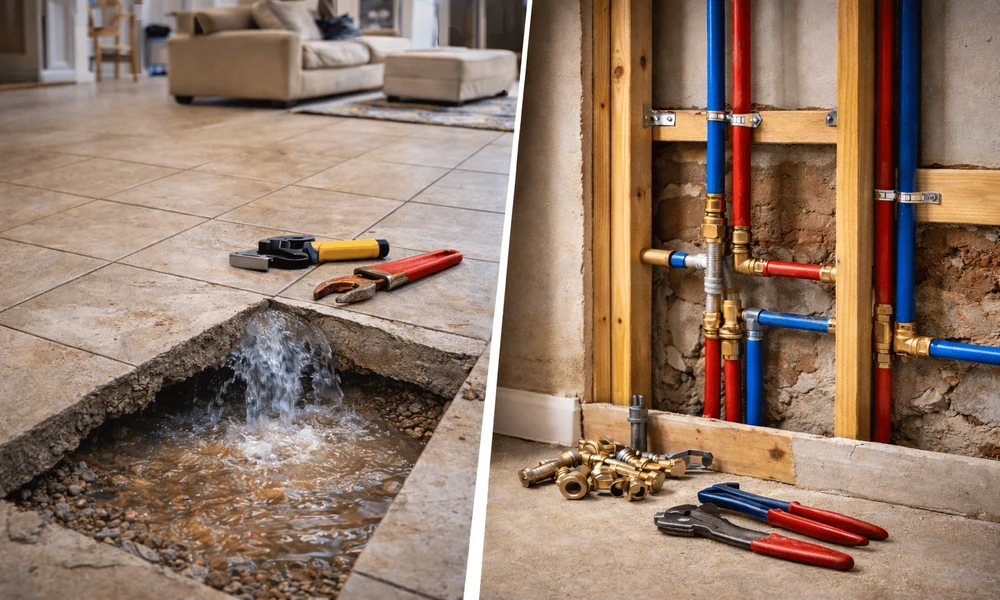
A slab leak usually announces itself sideways. The water meter keeps turning with every tap closed, a patch of tile feels warm underfoot, or the baseboard in one hallway swells while the rest of the house looks fine. Most homes across Orange County and the Inland Empire built from the 1950s through the 1970s sit on concrete slabs, with copper supply lines run through or under the concrete. After decades of hard water, soil movement and thermal cycling, those lines develop pinholes in places nobody can see.
The leak itself is rarely the hard part. The decision is. There are four common ways to fix it, and each one pulls against the others on cost, mess, risk and how long the fix will last. No option wins on every count, and the right pick depends on what the house is hiding and how long the owner plans to stay. The EPA’s Fix a Leak Week data puts average household leak waste at more than 9,300 gallons a year, with nine percent of homes losing 50 gallons or more per day. A pressurized line under a slab can sit at the far end of that range for months before anyone notices, which is why waiting rarely saves money.
Homeowners who want one crew to handle the plumbing, the floor and whatever turns up beneath it can call FWC, a Placentia contractor working across Orange County and the Inland Empire. The company holds a C36 plumbing license alongside its general building license, keeps certified asbestos, lead and mold workers on staff, and works directly with owners and insurance adjusters. That matters on a slab leak, because the plumbing fix often turns into a flooring, drywall and remediation job before the week is out, and emergency calls are answered around the clock.
The four repair paths
Before weighing anything, it helps to know exactly what each option involves.
Spot repair. The plumber locates the leak electronically, cuts through the slab directly above it, replaces the failed section of pipe and patches the concrete. It is the most targeted fix and usually the cheapest on the first invoice.
Reroute. The leaking line is abandoned in place and a new line is run through the walls, attic or along the exterior. Nobody breaks the slab, but drywall gets opened and patched along the new path.
Epoxy lining. The existing pipes are dried, blasted clean and coated from the inside with an epoxy resin. It avoids major demolition but depends on the pipe still having enough sound wall to coat, and it is not suited to every system.
Whole house repipe. Every supply line in the home is replaced, typically overhead with PEX or copper. It costs the most up front and opens the most walls, but it resets the clock on the entire system.
How the options pull against each other
| Repair path | Upfront cost | Disruption | Hidden hazard exposure | Odds of a repeat leak |
|---|---|---|---|---|
| Spot repair | Lowest | Concentrated in one room | High if flooring is old | Highest |
| Reroute | Moderate | Spread through walls | Low | Moderate |
| Epoxy lining | Moderate to high | Light | Low | Varies with pipe condition |
| Whole house repipe | Highest | Widest | Low to moderate | Lowest |
First cost versus the next leak
A spot repair fixes one hole in a pipe that is the same age and material as every other line under the floor. When one pinhole appears in 60 year old copper, others tend to follow. Owners who plan to sell within a year or two often accept that risk. Owners planning to stay a decade or more usually find that a reroute or repipe costs less than two or three separate trips through the slab.
Floor disruption versus wall disruption
Breaking the slab destroys the flooring above it. Tile can sometimes be matched, but hardwood and older laminate usually cannot, which means a single repair can turn into replacing flooring through an entire open plan space. A reroute leaves the floors alone and moves the mess into walls and ceilings, where drywall patches and paint are easier to blend. For homes with expensive or discontinued flooring, that trade alone often settles the decision.
What lies under the flooring
This is the consideration most homeowners never think about until the jackhammer stops. Older resilient flooring and the black adhesive beneath it can contain asbestos, and the EPA’s asbestos guidance is clear that materials like these should be tested before they are disturbed rather than after. In a house built or renovated before the 1980s, a spot repair through vinyl tile may require sampling and certified abatement before the concrete can be cut, which adds days and cost to what looked like the cheapest option. Rerouting and lining avoid most of that exposure because the floor stays sealed.
Water already in the building
Every path has to answer a second question: how wet are the slab, the bottom plates of the walls and the drywall right now? A leak that has been running for weeks may have pushed moisture well beyond the visible stain. Restoration crews follow the ANSI/IICRC S500 standard, which sets out how water damage is assessed, dried and documented. That documentation also tends to matter for insurance, since many policies treat the tear out and resulting damage differently from the failed pipe itself. Choosing a reroute does not remove the need to dry what is already soaked. It only means the floor does not get opened as part of the plumbing work.
Reading the trade-offs for a specific house
A few patterns tend to hold. A single leak in a newer home with modern flooring often justifies a spot repair, since the remaining pipe has plenty of life and nothing hazardous sits under the tile. A first leak in an original 1960s tract home with vinyl flooring usually points toward a reroute, because the pipe is likely to fail again and opening the floor carries real risk. A second or third leak in any house is a strong signal that the system as a whole has reached its end, and a full repipe stops paying for the same problem repeatedly.
Epoxy lining sits in the middle. It can work well in homes where walls are hard to open, such as plaster construction or units sharing walls in a multifamily building, but it needs a careful assessment of pipe thickness first. Lining a pipe that is already thin can simply delay the next failure.
The most useful step before choosing is getting three pieces of information on paper: the exact leak location from electronic detection, the age and material of the flooring above it, and moisture readings from the surrounding walls and slab. With those in hand, the trade-off stops being a guess and becomes a straightforward comparison of what each path will cost this house over the years the owner expects to live in it.
